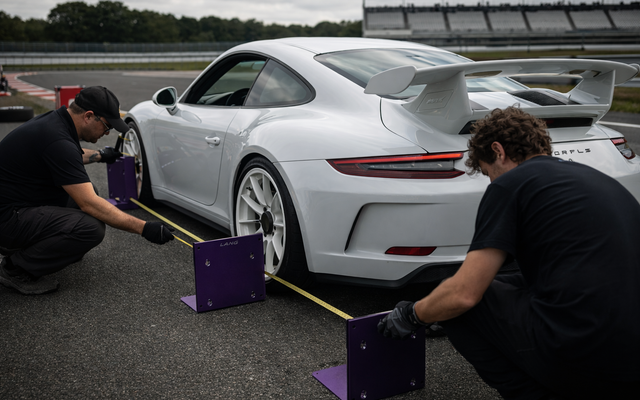
Within the intensely competitive realm of today's serious drifting, victory is no longer exclusively a function of brute torque or pilot aggression. Instead, it is now a multifaceted science which demands a painstaking blend of choosing a time-tested vehicle platform, arming it with the most precise competition parts, and, most essentially, understanding its real-time characteristics on the track through sophisticated vehicle dynamics analysis tools. This definitive guide functions as your roadmap from the initial idea of a project car through to the last engineering-refined tweaks that transform a capable machine into a predictable champion. We will delve deep into the methodical process of vehicle alignment optimization, illustrating how a advanced drift tuning app like precise measurement hardware removes guesswork and offers exceptional visibility into your vehicle's real-world dynamics.
The cornerstone of any exceptional competitive sliding vehicle is, undoubtedly, the chassis itself. Several cars have achieved renowned status within the international sliding culture due to their natural balance, durable build quality, and the enormous range of aftermarket parts available. Picking the correct platform is the initial and most crucial choice a driver will make. For instance, the the E36 generation BMW is commonly accepted as one of the greatest overall cars for drifting of history. Its near-perfect evenly distributed mass, coupled with a RWD setup and bulletproof straight-six powerplants, forms a chassis that is simultaneously easy to handle for beginners and extremely competitive in the possession of a professional driver. The successor of this concept, the BMW E46 platform, refines these strengths with a more sophisticated structure, broader wheel track for greater confidence, and yet more steering angle directly from the manufacturer. Another formidable contender in the professional arena is the Chevrolet Corvette C6.
This American sports car brings a unique set of advantages to the sideways sport, featuring a low-mass alloy structure, a transaxle-style gearbox and differential unit that aids in an ideal weight distribution, and the tremendous thrust of a powerful LS-series V8 engine. This blend renders it an complete monster on track, able of starting and maintaining extended slides with apparently easy application of throttle. For drivers seeking exceptional performance per dollar, the 350Z model Nissan rises above as a prime example. It comes from the manufacturer with a stiff body structure, a competent original locking differential, and the free-revving VQ series powerplant that provides sufficient horsepower and torque for practicing and moving up in the discipline. Its follow-up, the 370Z model, presents additional advancements in chassis stiffness, handling precision, and peak engine performance, solidifying its position as a popular pick among professional drivers. Additional iconic platforms that merit mention are the nimble unique FC generation RX-7, the ubiquitous S13 Silvia/240SX, the torque-rich Ford SN95, the more recent BMW E90, and the small yet unbelievably fun and forgiving Mazda Miata. All of these chassis offers a different palette of characteristics, complexities, and capabilities, but they all have in common the fundamental components essential to serve as a capable sliding vehicle.
However, picking the right car is just the beginning. To release the complete performance of any of these vehicles, major modifications to the steering system and damping and springing systems are utterly non-negotiable. This is where the domain of precision tuning parts comes into sharp view. The single most transformative upgrade for a serious drift machine is the fitting of a high-performance drift angle kit. These sophisticated kits, for example those engineered by performance brands like specialist manufacturers, are designed to radically increase the car's available turning lock. A OEM road car is severely restricted in how far its front wheels can rotate, a engineering limitation for daily operation. In oversteer driving, conversely, aggressive countersteering is constantly required to catch and maintain a angle. An modification kit exchanges the OEM hubs, linkages, and sometimes suspension arms with pieces that allow the steered wheels to achieve degrees of turn beyond 70 or even 80 degs, as opposed to a average OEM limit of around 40 to 50 degrees.
This immensely greater steering angle offers the operator with dramatically enhanced authority during a angle, enabling it to be far simpler to begin a oversteer moment, sustain it through a sweeping corner, and switch smoothly from one side to the other. The difference in handling is absolutely revolutionary. Combined with a appropriately specified modification is the just as vital upgrade to the vehicle's damping system. Store-bought or including premium street dampers are just not intended for the unique and harsh requirements of sliding. A dedicated pair of adjustable dampers is of utmost importance. These specialized dampers feature unique valving and spring stiffness that are tuned for the extreme load shifting that is inherent of sliding. When a pilot initiates a angle, the vehicle's weight is thrown forcefully to the outer of the corner. Proper competition coilovers control this transfer in a consistent fashion, allowing the car to stabilize quickly and offering the operator precise feel through the controls and cockpit. They furthermore allow for accurate adjustment of stance, damping firmness, and weight balance, which are all fundamental parts of fine-tuning the car's dynamics to a given track or driving technique. In combination, a precision-engineered steering angle kit and a expertly chosen system of competition suspension units are the core hardware cornerstone upon which all later refinement is based.
Once the essential parts is fitted, the following vital step in the build is the precise adjustment of the chassis's wheel angles. This is the world of car suspension tuning, a methodology that can feel overwhelmingly complex to the newcomer but is, in practice, the secret to transforming a set of capable components into a harmonious and consistent machine. The most debated parameter of suspension geometry for oversteer is certainly camber. Camber angle is the inclination of the tire compared to the upright axis when looked at from the front of the car. If the top of the wheel is leaning inward, this is known as inward tilt. For drifting, inward-leaning wheels on the front wheels is widely applied and is considered necessary. The purpose is fundamentally related to vehicle dynamics.
When a car is going around a bend at limit sideways angles, the chassis rolls toward the outside of the turn. This body roll makes the outside steering tire to lose its best footprint with the track surface. By introducing inward lean, the wheel is pre-angled to counteract this roll. As the car tilts into the bend, the outside front tire gains a better contact patch on the track, maximizing its traction at the exact moment when it is needed most for control. Usually, front axle adjustments for a serious drift car vary from approximately -3 degrees to as much as -5 degrees or even beyond, based on the parameters of the vehicle setup, compound choice, and pilot feel. The rear tires also utilize inward lean, but the values are typically more conservative and less aggressive than the front. Overly aggressive negative camber at the back can make the car excessively tail-happy and hard to control on throttle use, as it shrinks the effective tire footprint suspension tuning tool of the driven tires during linear acceleration. Hence, rear axle camber settings are frequently in the ballpark of -1 degree to -3 degrees, striking a delicate compromise between offering sufficient side bite to assist in starting and maintaining the slide while still preserving good grip for acceleration the bend. camber angle is merely one part of the more complex tuning puzzle, which furthermore encompasses toe setting, self-centering steering, and bump steer correction.
Toe angle describes the orientation of the wheels as seen from above. Inward toe means the front edges of the wheels are closer together than the rear edges, while toe-out means the converse. For sliding, a small amount of front negative toe is frequently run to quicken the initial steering reaction, making the chassis feel more agile and ready to initiate a drift. Rear axle toe is typically set to neutral or a very slight coilover setup tips amount of inward toe to encourage straight-line stability under acceleration. self-centering is the longitudinal or rearward tilt of the steering axis when looked at from the lateral of the vehicle. Increased caster angle improves steering feel and stability stability, and it additionally increases inward lean gain during steering, which is extremely beneficial. Adjusting these values is a intricate interplay where a adjustment to one setting can and often will influence the others. The traditional process for tuning a car's alignment for competition has historically been a labor-intensive process of guesswork and adjustment. A pilot or team would apply a change based on a hunch, test the car on track, depend on the operator's individual perception and feedback, and then introduce another adjustment. This loop would iterate time after time until the vehicle felt "good" or the scheduled practice period was exhausted. This approach is not only incredibly slow in terms of man-hours and tires, fuel, and parts, but it is additionally inherently inaccurate.
Pilot sensation is a notoriously inconsistent measurement tool, affected by countless variables such as exhaustion, changing track surfaces, ambient heat, and merely the mood of the driver on that specific session. What feels "oversteery" on one pass might feel "tight" on the following pass, causing contradictory data and frustrating changes. This long-standing limitation in vehicle dynamics optimization is specifically where modern technology has made its mark to revolutionize the landscape.
The advent and adoption of specialized vehicle dynamics tools has introduced a new era for engineering and refining competitive drift machines. This new generation of platforms, showcased by cutting-edge systems like modern telemetry hardware, work by physically measuring the real-time mechanical performance of the chassis as it is piloted on the course. Unlike relying on subjective feedback, these tools collect objective information on critical factors such as damper compression and extension, wheel speed, G-force loading, wheel angle, and throttle and brake input. This collected information flow is then analyzed by advanced algorithms that can graph and interpret the metrics in a comprehensible manner. For the first time, drivers and crews can see precisely what the car is exhibiting at every point of a slide. This capability changes the entire suspension tuning procedure. Consider the particular goal of dialing in the front axle camber for a given chassis. Instead of making a adjustment from -3 degrees to -3.5 degrees and then running several runs to try and "sense" a difference, a suspension tuning tool can give real-time and clear data. The tool can show graphically how the tire's loading is performing during the most important phases of a angle: turn-in, sustain, and changing direction. It can show if the existing camber setting is permitting the outside front tire to keep optimal contact or if the rubber is working inefficiently on its outer shoulder.
The tool can subsequently suggest data-driven advice for change. Perhaps the information shows that the outside front tire is even stressing its sidewall at -3.5 degrees of camber, indicating that even more inward lean, say -4 degrees, might be warranted. Alternatively, the information might show that the tread is failing to reaching heat or that the inner edge is degrading unevenly, which could point to that there is too much angle and a modest lessening back to -3.2 degrees would be more ideal. This degree of precision and actionable insight was simply impossible in the time of solely manual setup.
The impact of utilizing a comprehensive vehicle dynamics tool extends far beyond merely setting camber angles. It serves as an invaluable coilover setup tips that is tailored to your exact vehicle. When fine-tuning the rebound and compression settings on your suspension, instead of relying on general tips or mimicking another driver's settings, you can use the telemetry to analyze how the car is behaving in response to your changes. The application can display the damper movement trace over a run, revealing if the dampers are controlling the chassis motion properly or if they are allowing the car to become unsettled too much after a direction change. It can assist in identifying issues like hitting the bump stops or excessive extension, allowing you to apply informed choices to helper springs, rebound/compression rates, or ride height. This methodology translates just as well to the intricate process of corner balancing. In addition to camber angle, the software can offer analysis into how modifications to toe and caster are influencing the vehicle's handling during different parts of a slide. For instance, it can help you to find the best amount of front toe out for your individual steering configuration and piloting approach by showing the speed of initial response and the consistency of the vehicle at full countersteer. This transforms the system an extremely useful performance optimization handbook that is dynamically informed by the actual dynamics of your specific chassis on the track. It moves the complete project from a dark art into a repeatable development procedure.
Furthermore, the application of a tool like GripDial is not confined to expert tuners with large budgets. For the amateur competitor, it functions as an incredible force multiplier. It in essence provides the tuner with the insight of a expert suspension specialist without the typical overhead. It drastically shortens the learning curve by delivering clear directions to problems that would normally take seasons of experience to solve. A tuner can learn how their particular chassis responds to specific settings, building a more intuitive comprehension of suspension theory in the endeavor. It additionally democratizes high-level suspension engineering concepts, permitting all drivers with the drive to refine their car to do so in a structured and productive way. This is especially significant in a discipline like sliding, where engineering knowledge has in the past been a highly secretive advantage among professional teams. Now, that knowledge can be in the garage of any motivated builder.
In summary, the journey to building and optimizing the ultimate championship-contending drift machine is a multi-faceted mission that smoothly combines proven hardware wisdom with revolutionary data tools. It starts with the wise choice of a capable chassis, then built upon the integration of essential drift-spec components like drift-spec steering angle kits and properly selected competition coilovers. The journey then advances into car suspension tuning the intricate phase of car suspension tuning, where settings like negative camber, toe, and caster are precisely configured to suit the car's modified geometry and the pilot's personal needs. Finally, and what truly separates the modern approach from the past, is the integration of a sophisticated suspension tuning application. This tool eliminates the uncertainty and trial and error of purely seat-of-the-pants tuning by delivering empirical, real-time data on how the car is really performing. It serves as an unparalleled engineering partner, a comprehensive alignment optimization handbook, and a all-in-one vehicle dynamics tool. In unison, this holistic methodology leads to that every component of the competition vehicle—from the pick of the platform to the final tweak on the coilover—is optimized for peak performance on the circuit. It embodies the full maturation of the art of sliding, bridging mechanical driving skill with surgical vehicle setup to create the perfect competitive machines imaginable.